
ISEE Score Reports for Families


Online tests
Scores from online test administrations are usually ready in three to five days.
Paper tests
Scores from paper test administrations are usually ready in five to ten days.
Understanding Your Student's Score Report
The Individual Student Report (ISR) provides member schools with information about a student's performance on the ISEE. Schools receive these score reports when families designate them as a score recipient.
What Does the ISEE Measure?
Accepted by more than 1,200 independent schools globally, the Independent School Entrance Exam (ISEE) is a trusted admissions assessment tool available for students in Grades 2-12. The ISEE predicts academic success in independent schools. E3n member schools, such as the ones your student is applying to, use ISEE test scores as one scientifically validated measure with which to make admission decisions, in addition to other criteria deemed important for entry to their school.
The ISEE is comprised of the five sections below, listed in their testing order. Each section is designed to tap into a unique aspect of a student's preparation for academic work.
Learn even more about each test section in our What to Expect on the ISEE Guides.
Verbal Reasoning
This section comprises two different kinds of questions: synonyms and sentence completions. Both questions test vocabulary and reasoning ability.
Quantitative Reasoning
This section measures how students use their understanding of mathematics to approach math problems. These math problems may ask students to estimate, employ logic, compare quantities, analyze data, interpret graphical information, understand measurements, or arrive at statistical solutions. This section does not test the amount of math students have learned, but how well they think mathematically; for this reason, Quantitative Reasoning questions require little or no calculations.
Reading Comprehension
This section contains reading passages and accompanying questions about these passages. The types of questions assess students’ ability to understand main ideas and supporting ideas in a passage, make inferences, apply context clues to define vocabulary, analyze a passage’s use of organization and logic and its use of tone, style, point of view, and figurative language.
In addition to Reading Comprehension, students taking the Primary 2 Level will complete an Auditory Comprehension section that requires them to listen to a passage without seeing the text on the screen. The student then listens to the questions while seeing the text of the questions on the screen. These types of questions assess students’ ability to understand main ideas, supporting details, vocabulary, and other features of the text they listened to.
Mathematics Achievement
This section tests students’ ability to identify and solve problems linked to the following National Council of Teachers of Mathematics (NCTM) strands: numbers and operations, algebra, geometry, measurement, data analysis and probability, and problem solving. Unlike the Quantitative Reasoning section, students may need to do calculations to determine the correct answer while some questions may require knowledge of the mathematical terminology found in those NCTM standards.
Essay
This section asks students to write a short essay in response to an assigned writing prompt. A writing prompt is randomly selected for use on each test date. The writing prompts include topics relevant to students at various grade levels and are developed to give students an opportunity to tell schools more about themselves, and how well they organize their thoughts and express them in a written format. In order to maintain test integrity and the security of essay prompts, families do not receive a copy of their student's essay. Only the schools with which you choose to share scores will receive a copy of the essay.
What Information Should You Consider Before Reviewing Your Student's ISR?
It's a norm-referenced test
The ISEE uses a comparison group of students who have taken the ISEE over the past three years to calculate the statistical information you see on your student’s score report. These comparative groups are called norms.
Each year, scores from students who took the exam for the prior three years are compiled by grade and used to calculate percentiles. These percentiles are further categorized into stanines, which divide the distribution of performance into nine differently sized groups. These terms are further explained below.
Each test form is assembled to the same specifications
New forms or versions of the ISEE are introduced every year. Each form has different questions, but is developed according to strict specifications for test content and difficulty. E3n creates a unique score conversion for each of these forms that adjusts students’ scores for minor differences in form difficulty.
The careful ISEE assembly process, combined with these statistical adjustments, ensures that scores from different forms of the ISEE are fully comparable. No student is at a disadvantage based on which iteration of the ISEE they take.
Each multiple-choice section of the ISEE contains several questions that will not be scored but may be used on future editions of the ISEE.
The testing population varies from the overall student testing population
It’s important to note that students applying to independent schools are generally of a higher ability and achievement level than students in the overall student population; consequently, in comparison to this smaller, more targeted ISEE norm group, your student’s performance on a given section of the test may appear to be considerably lower than what you may be used to seeing.
How Do I Manage My Score Recipient List?
Families can choose whether or not to share their score reports with applicant schools. The choice is yours. The fastest and easiest way to manage your student's list of score recipients is from your parent account online.
Families will always automatically receive a copy of their student's score report but you are not required to share your student's scores with any school. If you choose to share your student's scores, you can select score recipients at the time of registration or after viewing your student's scores.
There is no extra fee for adding schools after the report is generated. However, always be mindful of school application deadlines as you decide when to share scores.
You may remove schools from your score recipient list up until your student's test date—schools cannot be removed from the list after your student tests.
Only a complete score report can be sent to a school—families cannot select only portions of a report to share, nor can they select one section of scores from one ISEE test and another section of scores from a different ISEE test.
Your student's list of score recipients is not shared with any schools.
I'm reviewing my student's score report.
What does all this information mean?
Test Profile

Sections, Scores, Ranks
ISEE scaled scores for each section range from 760 to 940. The scaled score is derived from a student's raw score—the number of questions the student answered correctly. The scaled score is more useful than the raw score because the scaled score has the same meaning regardless of which form of the assessment is used. E3n administers multiple versions of the test each year. The scaled score takes these slight differences into account and allows E3n to report a score on a common scale that has the same meaning for all students regardless of the form of the test that was taken.
A percentile does not indicate the percentage of questions that your student answered correctly. Rather, it indicates what percentage of students from 1 to 99 had the same or lower scores than your student's score. For instance, if a student’s score report showed a percentile rank of 70 in Mathematics Achievement, this would mean the student scored as well as or better than 70% of other students on this section. This group of other students that your student is compared to—called a norm group—is based on the scores of all other students in a given grade who took the test during the past three years.
A stanine is another way of comparing your student's performance to the performance of other students. Stanines are calculated by dividing the scores of all students in a group into nine subgroups, called stanines. These stanines are numbered one to nine, lowest to highest, and different percentages of students fall into each stanine. For example, stanines 4, 5, and 6 in the center of the distribution represent the middle 54 percentile points, whereas stanines 1 to 3 and 7 to 9 represent the bottom and top 23 percentile points, respectively.
The Stanine Analysis includes a shaded range around each stanine based on a student’s actual stanine score plus or minus one stanine. Because no test is a perfect indicator of a student’s ability, this shading accounts for the tendency that a student’s score can vary if they retake the exam, even if their skill level remains the same. Thus, if a student has received a stanine of 5 for Verbal Reasoning, the Stanine Analysis graph will show a band stretching from 4 to 6. In other words, the observed stanine score of 5 represents a true stanine score somewhere between 4 and 6.
Sections, Scores, Ranks
Analysis
The Analysis section gives a clear breakdown of the number of questions in each section. The legend key explains the symbols and terms in the results area.
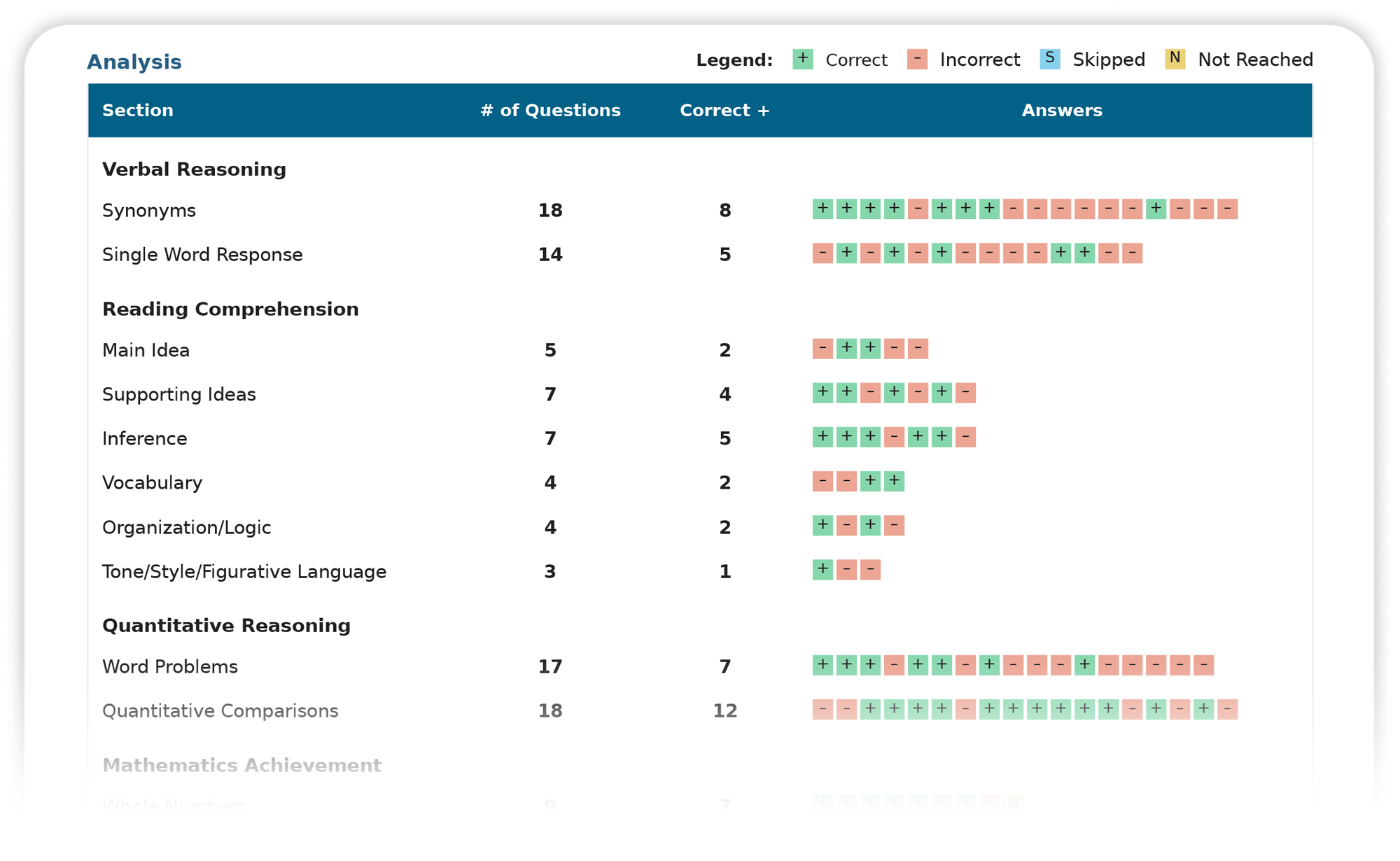
The Analysis section gives a clear breakdown of the number of questions in each section. The legend key explains the symbols and terms in the results area.
How Can My Student Prepare for the ISEE?
Use a Test Innovators Preparation Package
Test Innovators ISEE test preparation website is the only place where your student can take multiple E3n-approved full-length ISEE practice tests and receive real-time feedback and performance insights.
Get Our What to Expect On the ISEE Guide
Our What to Expect on the ISEE materials provide a free, comprehensive overview of the ISEE, including sample questions and full-length practice tests.
Optional Scoring Services
Or call ISEE Operations at
1 (800) 446-0320
or (646) 503-2691.
Hand-Scoring
Hand-scoring is available for paper tests only.
Re-Scoring for a Different Grade
In certain circumstances, a student's test can be re-scored for one grade below or above the application grade noted in the student's registration information. However, this is generally only done when the student is under consideration for repeating a grade. Due to differences between test levels, not all grades can be rescored.
Which Grades Can Be Rescored?
Want More Information About ISEE?
Score Interpretation
For questions on how schools will interpret your student's scores and use them as part of their admissions process, please contact the admissions office at the schools with which you shared your student's scores.